
El Salvador’s representative for the Venice Biennale
Gabriel Diego Delgado
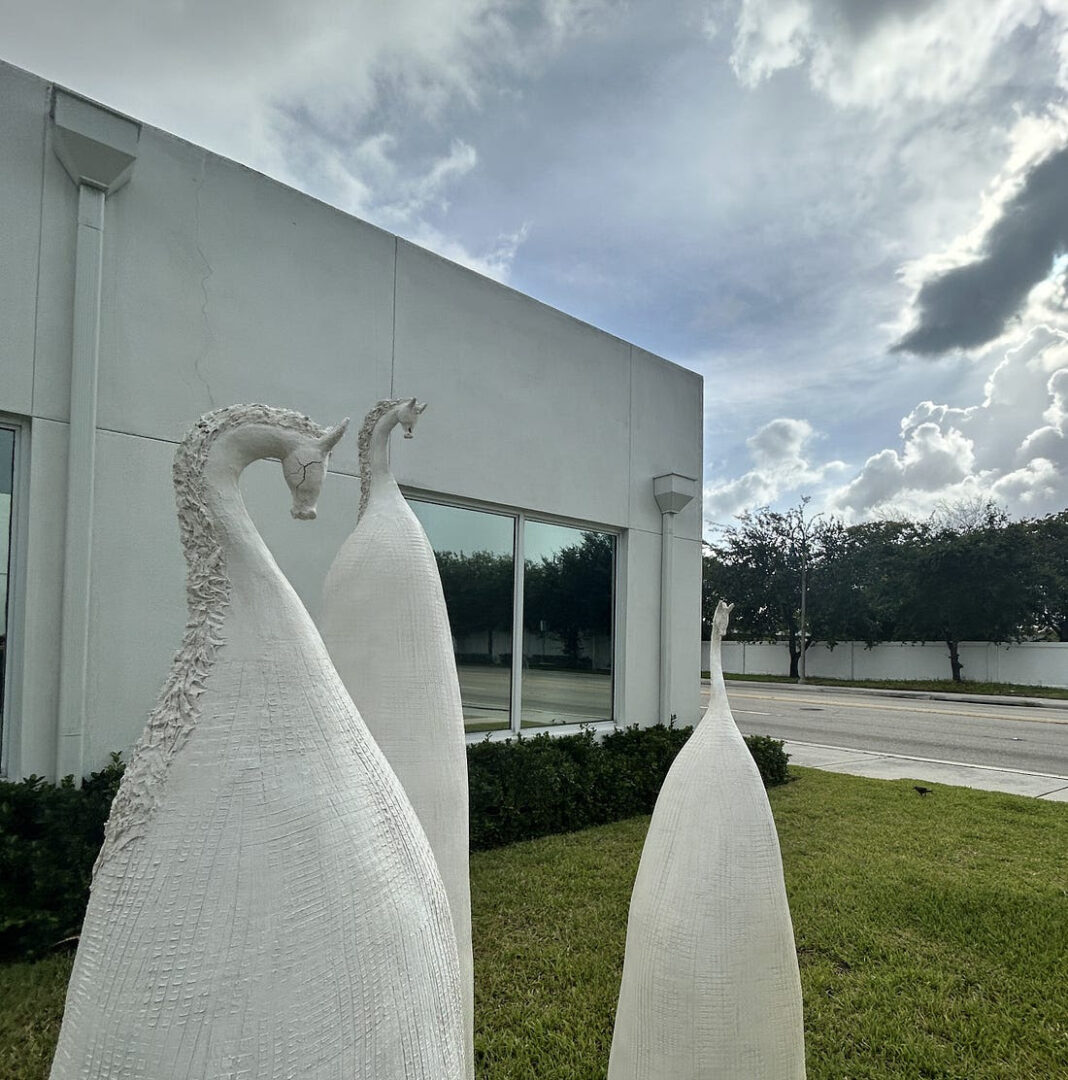
As both a political artist and an art historian deeply invested in the intersections of politics, labor, identity, and contemporary visual culture (social or psychological), I have found myself increasingly captivated by Oscar Molina’s The Herd, installed on the campus of Palm Beach Modern Auctions through a partnership with the Julie Keyes Gallery in Sag Harbor.
Over the course of several months, these sculptures have become part of my daily visual consciousness, shifting from ornamental objects within the landscape into psychologically charged presences that continually reveal new layers of meaning.

Molina, who was selected as El Salvador’s representative for the Venice Biennale, operates within a lineage of artists whose practices are inseparable from histories of displacement, political instability, and diasporic experience.
Knowing the artist’s own immigration narrative profoundly alters the reading of these works. The horses function as symbols of nobility or aesthetic elegance ; instead of his figurative and allegorical vessels of endurance, migration, sacrifice, and survival.
What I find particularly astute within Molina’s practice is the manner in which he deploys visual seduction as a strategy of political infiltration. These sculptures are extraordinarily palatable within the language of contemporary design, architecture, and luxury aesthetics.

Their elongated forms possess an almost Brâncuși-like reduction, while their textured surfaces carry an expressionistic materiality that feels scarred, weathered, and psychologically burdened. Rendered in luminous white, they appear almost spectral against the South Florida atmosphere, particularly at dusk when they begin to resemble apparitions quietly occupying the edge between memory and myth.
Yet beneath this beauty exists a restrained but deeply subversive political undertone. The works do not announce themselves through overt didacticism, but instead operate through suggestion, implication, and metaphor. This tension is precisely what makes them compelling to me as both a scholar and practicing artist.
Molina understands that contemporary political art need not always rely upon explicit imagery or confrontational rhetoric to carry ideological weight. Instead, The Herd functions through a quieter and perhaps more insidious mechanism: the normalization of trauma through beauty.

The horses become apparitions of valiance, determination, and collective resilience, embodying the psychological aftermath of migration while remaining visually accessible to audiences who may otherwise resist politically charged content.
In this sense, Molina has achieved something remarkably sophisticated: a body of work capable of existing simultaneously as public sculpture, decorative object, memorial form, and coded political testimony.
